

If you are a business leader at a financial institution, you’re probably thinking about the new challenges around how—and whether—your calls even get answered! Under new mandates from the Reserve Bank of India (RBI) and guidelines in the Telecom Commercial Communications Customer Preference Regulations (TCCCPR), you’re required to use 140 or 160 series numbers for all promotional and service-related calls. These regulations are designed to protect consumers by filtering out spam and fraud.
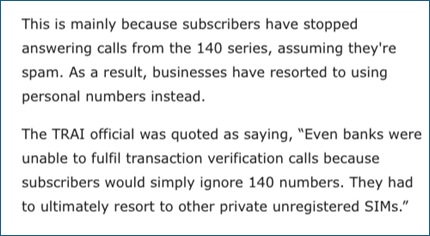
But there’s a growing problem: customers are ignoring or blocking even legitimate calls. A recent report from the Times of India highlighted how even banks struggle to complete important verification calls because customers often ignore 140-series numbers. In some cases, institutions resorted to using personal numbers just to get through—an unintended consequence that opens the door to fraud and erodes trust. And that’s not just an inconvenience—it’s a barrier to business, affecting both service delivery and revenue.
TrueCaller to the rescue! Or not?
Literally every financial institution in India has a deal with TrueCaller, which is an indication of exactly how prevalent TrueCaller is. But if you think that TrueCaller will rescue your 140-series calls from falling into the spam abyss, I’ve got news for you. Here is a screenshot of TrueCaller’s settings. Notice the highlight?
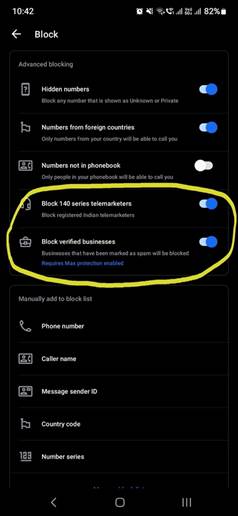
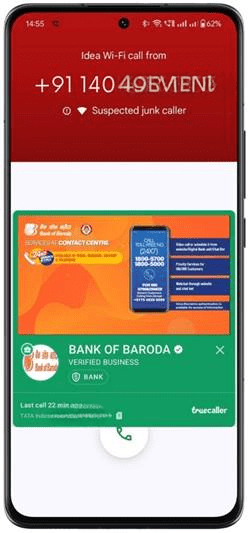
Interesting, eh? Not only does TrueCaller allow customers to BLOCK 140 numbers automatically, also TrueCaller blocks verified businesses that have been marked as spam by customers!
So, to summarize the problems of 140 and 160 number series, if you run a financial business, then:
- RBI expects you to make calls via 140-series numbers
- Customers DO NOT see these calls as providing value
- TrueCaller BLOCKs these numbers, even though these are from verified legitimate businesses
- Other dialer apps also mark these numbers as SPAM
- You see the whole thing as stupid, stupid, stupid!
What are customers looking for?
For a call to be perceived as useful and trustworthy, your customers expect answers to three basic questions:
- Who is calling?
- Why are they calling?
- Is this the right time to take the call?
If any of these questions go unanswered, the call is likely to be ignored, blocked, or marked as spam—even if it originates from a compliant number. It’s kinda sad that we have reached the point where literally no one wants to pick up a call from an unknown number, or even from a known commercial number, because they assume it’s all spam!
What Your Enterprise Needs from Customer Outreach
As an enterprise, you likely want to:
- Increase engagement and meaningful conversation rates
- Reduce wasted operational effort on unanswered or unproductive calls
But in today’s environment, this has become a challenge – how can you even have engagement when customers don’t pick up calls? So, the industry response to falling call pickup rates has been to:
- increase the number of calls attempted
- rotate numbers
With RBI’s regulation around 140, 160 series kicking in, part 2 is no longer feasible. And part 1 is less and less productive. Let’s admit it – the problem cannot be solved this way!
Bridging the Gap with Assertion Identity Assurance
When you implement Identity Assurance in your mobile app, you introduce a structured way to improve the utility of RBI-compliant calls. It works by giving customers enhanced information and flexibility around incoming calls.
1. Pre-Call Notifications
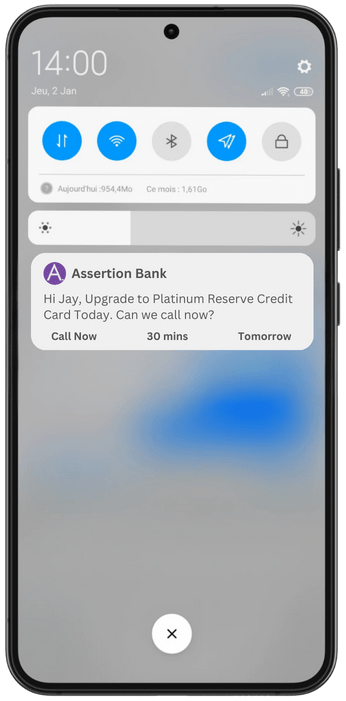
Before you place a 140/160 series call, your app can send an in-app notification showing:
- Your company’s name
- The reason for the call with personalization(e.g., “Hi Jay, Credit Card Upgrade”)
- An option to reschedule the call according to their convenience
This offers transparency and allows the customer to choose an appropriate time, making conversations more relevant and productive.
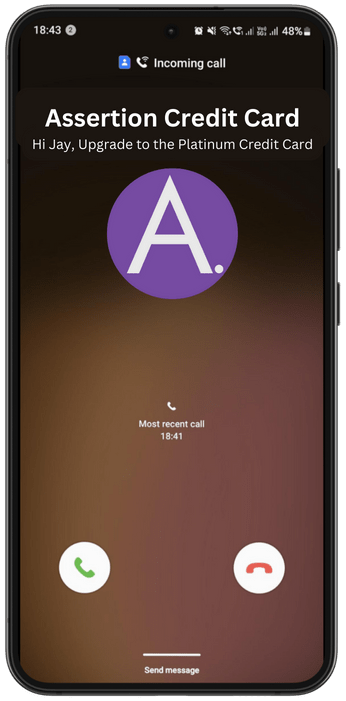
2. In-Call Context and Branding
When the call connects, your customer sees:
- Your company’s name and branding
- A summary of the call’s purpose with personalization
This increases the chance that your call will be accepted by a customer who recognizes your brand and understands the context.
3. Post-Call Recovery Options
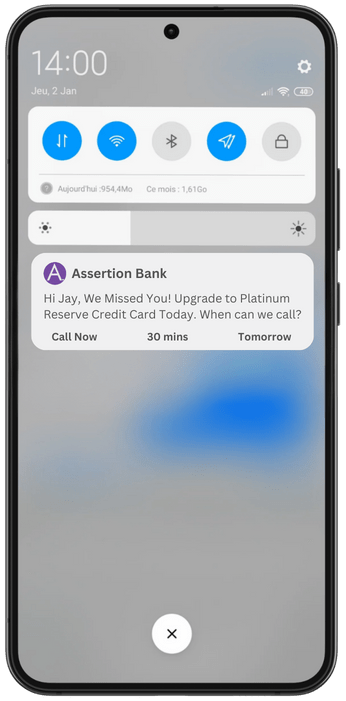
If your customer misses or declines the call, they can:
- Receive a follow-up message with details of the missed communication
- Reschedule the interaction at a more convenient time
This helps you recover missed opportunities and improve lead management and customer satisfaction.
Staying Compliant While Improving Experience
The Identity Assurance process complements your existing regulatory obligations:
- You still place calls using your registered 140/160 numbers
- You manage customer consent through integrated flows that can connect to DLT systems
- You don’t bypass or mask telecom identifiers
This approach lets you stay compliant while providing your customers with greater clarity and control.
Conclusion
As regulatory frameworks aim to curb fraud and enhance consumer protection, you need to maintain effective engagement at scale.
By adding transparency, timing flexibility, and post-call recovery to your calling infrastructure, Identity Assurance helps you bridge the gap between compliance and customer experience.
The goal isn’t to work around regulations—it’s to make them work better for both you and your customers.