

Your outbound calls are being judged long before a customer decides to answer. Every dial you make is scored by telcos based on answer rates, call duration, and user behavior. That score determines whether your call shows up as trusted, “Spam Likely” or much worse get’s declined at the network level. Most businesses don’t even know this is happening until their connect rates drop and numbers start getting burned. In this article, we break down how number reputation actually works, how to detect when your numbers are being flagged, and most importantly, how to take control of it using responsible dialing.
What is number reputation and who decides that?
Outbound dialing is controlled by TCPA and various federal and state rules.
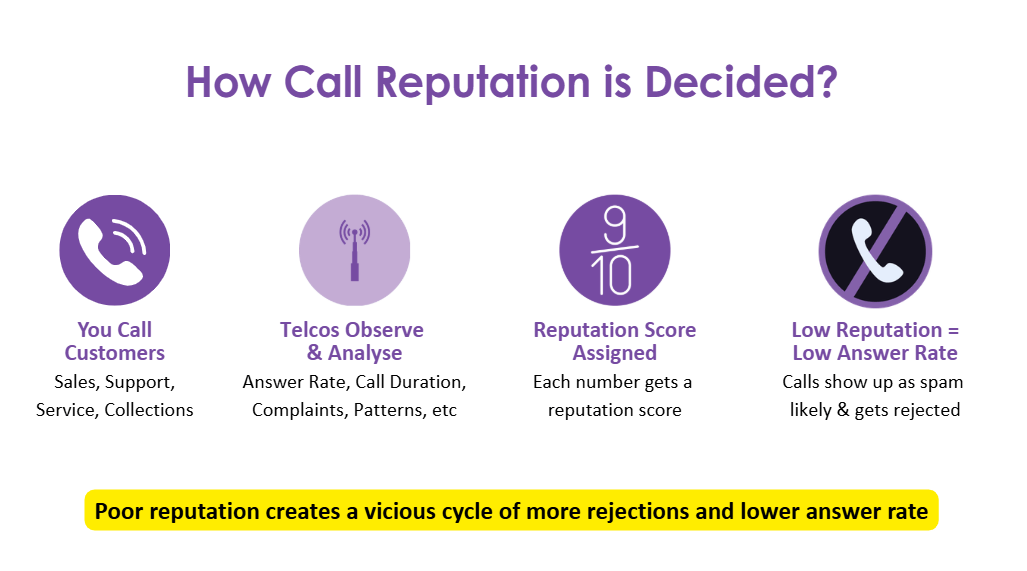
You buy numbers from your telco and you call your customers – be it for sales, service, support or collections. The telcos see who you call, how much you call, how many of these calls get answered, how long are the conversations etc., and they assign a “score” to each number called the “reputation”. If your calls go unanswered or declined by users, or if the connected duration is very less (say below 15 seconds) you get downgraded. Multiply that by 100s or 1000s of calls and your numbers’ reputation starts to fall.
If the reputation is below a threshold, your calls will start showing up as “spam likely” on the end user mobiles. And when that happens, they are more likely to reject the call because they see it as a “spam call”. It accelerates the cycle further.
How do you know if your numbers are tagged in the first place?
To know if your numbers are tagged as spam, there are 2 ways – one is what you can do, the other is to pay someone. We are going to stick with self-help in this article.
There are 2 things in your control:
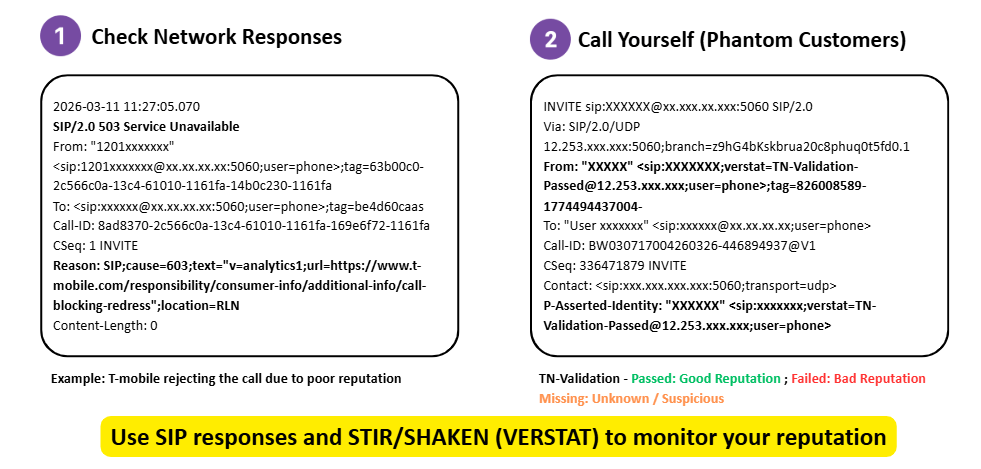
- Look at the network response: When it rejects a call because of reputation of the number, there is a good chance that it will let you know about it. Here is a response from T.mobile for a call it refuses to terminate. Please note that in this case T.mobile is the terminating telco (originating telco was different, and it does not matter).
- Call yourself: Get a few sip trunks and numbers from 2-3 telcos across the country and pipe it back into your system – let’s call these numbers “phantom customers” since they will be emulating customers for us. Make sure these telcos support STIR / SHAKEN header on the incoming trunks. As part of the outcall campaign, call these “phantom customer” numbers. Now, you will know what the telco thinks of the reputation of your outbound number when you receive the call back by looking at the VERSTAT information. This may not be 100% accurate, but it’s a good heuristic. The below is an incoming SIP message from AT&T – notice the TN-Validation-Passed. This tells you that your numbers’ reputation is good. It could be “Passed” (reputation is good), “Failed” (reputation is bad) or be missing (reputation is unknown / suspicious).
What do you do when your numbers’ reputation falls?
If that happens, you had only 2 logical ways out:
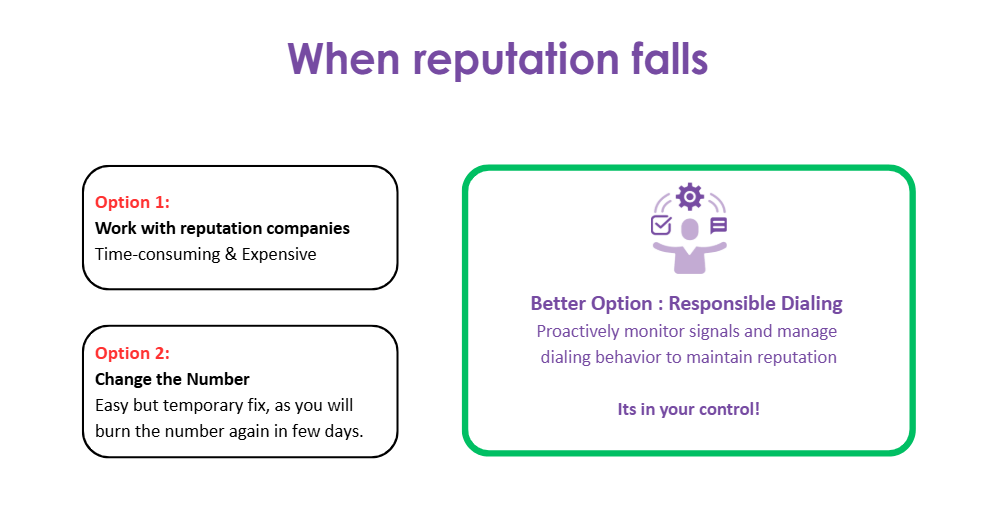
- Work with number reputation companies that can work with the telcos, justify to them why you are making these many calls and work your numbers’ reputation back up. This costs a lot of time and money.
- Or you change the number you call from and move on. Yes, this will “burn” the number in a few days, but it’s easier and cheaper. Most businesses do this.
But there is one more option I want to talk about – Responsible dialing. Can we not watch the signals and manage them such that the numbers’ reputation is maintained? Yes, we can. And the best part is, it is completely in your control.
How can you dial responsibly while maintaining your numbers’ reputation?
This list may not be exhaustive and each telco’s reputation algorithm may be different, but these are best practices that will go a long way in maintaining your numbers’ reputation.
- Watch Network rejects. On the first network reject based on “reputation” you stop using that number for at least 4 weeks. Then if it still happens, just let go of that number. We do not want 1 number to damage the reputation of other numbers and of your brand.
- Watch Time of Day failures. You want to manage your pacing ratio such that not too many calls are getting rejected – either by the network or by end consumer. Seeing the failed traffic across time gives us a better idea of when things are the worst. In the table below you can see that between 5pm – 6pm, 6pm – 7pm and 7pm – 8pm a significant number of calls are not being connected (failing). This is a red flag. It would be good to keep the failed ratio to under 30%, lower the better of course.
- Watch Call duration. Now this is a touchy topic and depends on why you are calling and who. A 15 second connect time is considered good and telcos will see it as a “valid call” (not spam).
- Watch Agent connect time. If customer answers and agent does not within 3 seconds, that’s a red flag as per TCPA. So, make sure either you do manual / preview dial or if you must do predictive, make sure agent (or bot) is connected within 2 seconds. I am a little doubtful about this, but it was told to me by a large customer, so I am adding it to my list.
5. Bonus for the very evolved customer: Sign your call.
You can get the approval from FCC to sign your own call – the same verstat parameter that you saw in the trace above can now be inserted by you. You will need a few approvals for this and the means to do so, but it is possible. Since you know your customers best, and have their consent to call, and take responsibility for the numbers you are calling from, this can be amazing for you. By signing the call yourself as attestation level A (which translates to TN-Validation-Passed), you are signaling to the network to “trust” your call. Now, your calls will not longer be tagged as spam, since all the telcos are part of this “trusted” network.
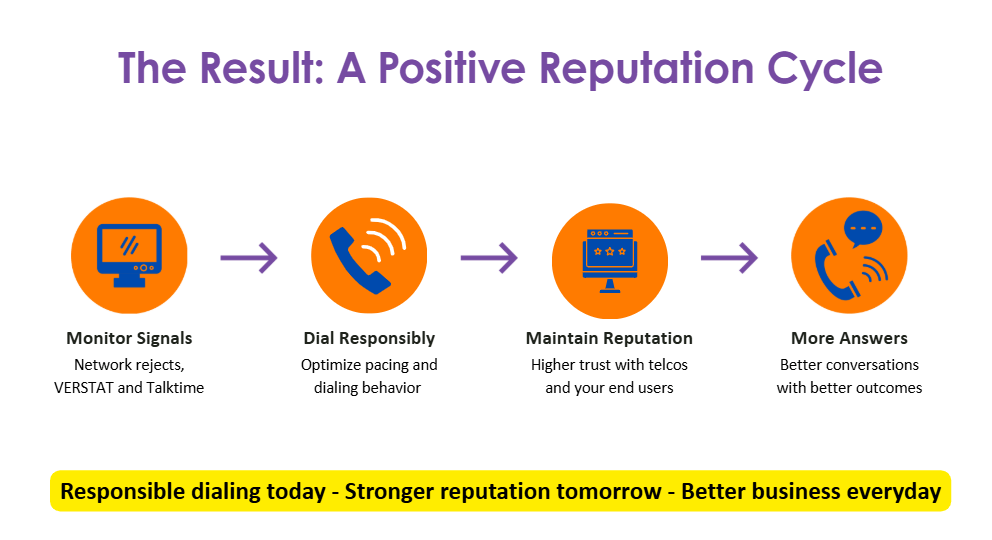
In the end, number reputation is not a telco problem, it’s an operational discipline. The same signals that get you flagged as “spam likely” are the ones that reveal inefficiencies in your dialing strategy, customer engagement, and compliance posture. Businesses that continue to rotate numbers are only masking the problem, not solving it.
The real advantage lies in actively monitoring network feedback, adapting dialing behavior in real time, and building a system that protects reputation at scale. This is exactly where Assertion Secure Voice changes the game by turning number reputation from a reactive firefight into a controlled, intelligent system. Instead of chasing deliverability, you own it. And when you own your number reputation, you don’t just improve answer rates, you restore trust in every call you make.